 Image: Winbuzzer / OpenAI
 OpenAI Brings Codex Into the ChatGPT Mobile App
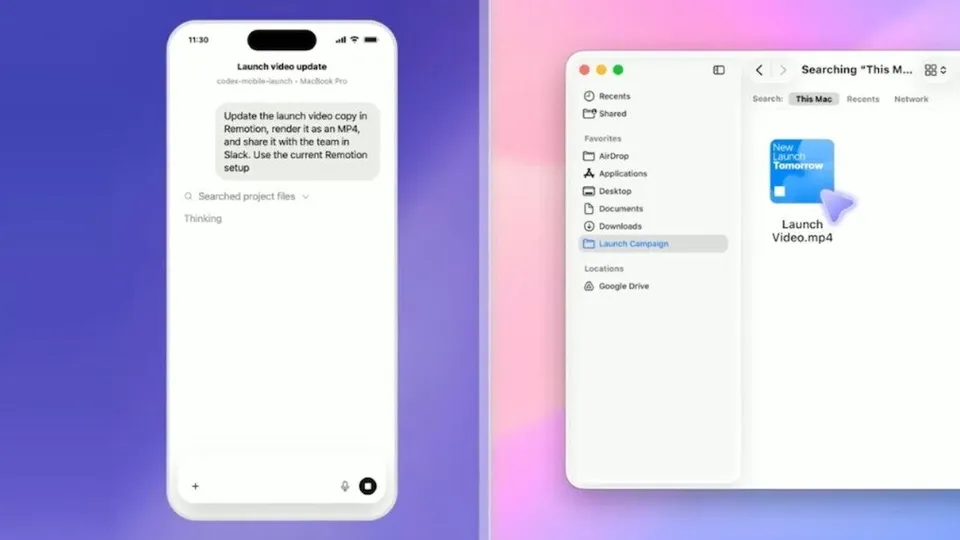
OpenAI added Codex access to the ChatGPT iOS and Android apps on May 14. Your phone connects to a Codex session running on your Mac via QR code, letting you review outputs, approve commands, and start new tasks from anywhere.
OpenAI added Codex access to the ChatGPT mobile app on May 14, making it available on iOS, iPad, and Android. The feature is in preview and rolls out across all ChatGPT plans, including the free tier.
The announcement describes it simply: “Codex is now in the ChatGPT mobile app so you can stay in the loop from anywhere while Codex gets work done across your laptops.”
How the connection works
Your phone doesn’t run Codex. It acts as a remote control for a Codex session running on your Mac. Setup requires updating both the Codex Mac app and the ChatGPT mobile app, then scanning a QR code that the Mac app generates. After that, the connection is live.
From the phone, you can work across all open threads, review outputs, approve commands, switch between AI models, and start new tasks. Updates flow back to the phone in real time: screenshots, terminal output, diffs, and test results. When Codex needs approval to proceed, the request comes to your phone.
Files, credentials, and local permissions stay on the host machine throughout. Nothing sensitive moves to the phone side of the connection.
Windows support isn’t available at launch. OpenAI confirmed it’s coming but hasn’t given a timeline.
Why this matters
OpenAI’s own numbers put Codex at 4 million weekly active users, up 8x from the start of the year. The mobile integration gives those developers a way to stay connected to running sessions without staying at their desk. For long-running tasks, that’s genuinely useful.
Anthropic launched a similar feature for Claude Code in February 2026 under the name Remote Control. The Claude Code implementation was part of the desktop app redesign. OpenAI’s version is built into ChatGPT’s mobile app rather than a standalone Codex app, which gives it broader reach since ChatGPT already has a large installed base on phones.
The mobile app integration also follows recent Codex expansions: background operation capabilities in April, and the Codex Chrome extension (which lets Codex interact with browser tabs using your signed-in credentials) in early May. The pattern is consistent: OpenAI is connecting Codex to more surfaces rather than keeping it confined to the terminal.
Sources:
- OpenAI brings Codex to ChatGPT for iPhone, iPad, and Android — 9to5Mac, May 14, 2026
- OpenAI Brings Codex Remote Access to ChatGPT Mobile App — MacRumors, May 15, 2026
- OpenAI says Codex is coming to your phone — TechCrunch, May 14, 2026