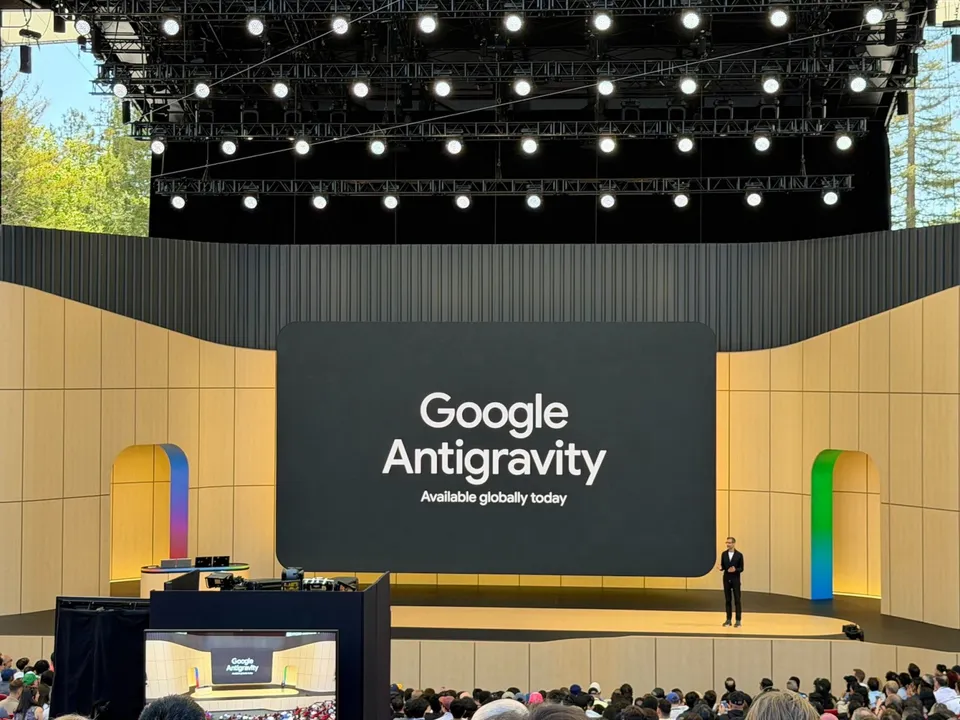
 Image via TechCrunch / Google
 Google Launches Antigravity 2.0 at I/O: Desktop App, CLI, SDK, and Dynamic Subagents
Antigravity gets a full re-launch at Google I/O 2026. Standalone desktop app, new CLI, public SDK, dynamic subagents, scheduled background tasks, and a new $100 AI Ultra tier. Here's what shipped and what it changes.
Google re-launched Antigravity today at I/O 2026 as Antigravity 2.0. The original platform shipped in November 2025 as a VS Code fork with multi-agent coordination baked in. Six months later, Google has rebuilt the surface: a standalone desktop app replaces the editor, a new CLI ships for terminal-first workflows, and a public SDK gives developers access to the same agent harness Google’s own products run on.
This is Google’s most direct answer yet to Cursor, Claude Code, and the long list of coding agents that have crowded into the developer market in 2026. The pitch shifted from “another IDE” to “the home for everything you’d want an agent to do.”
What’s New in Antigravity 2.0
The three product surfaces are now:
Antigravity Desktop App. A standalone application that Google describes as “a central home for agent interaction.” The big change from the original VS Code fork is the orchestration model: you can run multiple agents in parallel, design custom subagent workflows visually, and schedule agents to run on triggers (cron-style, file-change, webhook). Integrations now reach into Google AI Studio, Android, and Firebase directly. The app exports projects out to local development environments with one click for anyone who wants to drop back to a regular editor.
Antigravity CLI. A new terminal-first surface for developers who don’t want a graphical interface. Google explicitly positions this as the successor to the Gemini CLI, and the company published a transition guide the same day. Existing Gemini CLI users are encouraged to migrate. The CLI hits the same agent harness as the desktop app, so workflows defined in one show up in the other.
Antigravity SDK. This is the surprise. Google has opened the agent harness that powers its own products, letting developers build custom agents and run them on whatever infrastructure they want. The SDK ships with the same model defaults, tool definitions, and execution model as the hosted Antigravity service. For teams that need agents inside their own VPC or behind their own auth layer, this removes the previous reason to roll a custom harness from scratch.
Dynamic Subagents
The standout capability across all three surfaces is dynamic subagents. The original Antigravity had a fixed pattern of one orchestrator and a small number of worker agents. The 2.0 version supports parallelized workflows where the orchestrator can spawn subagents at runtime, hand them sub-tasks, and merge their outputs back into the main workflow. Scheduled tasks make the same primitive available for background automation: an agent can be configured to run every weekday at 9am, scrape an RSS feed, summarize the day’s news, and post it to Slack, all without anyone clicking a button.
Combined with Managed Agents in the Gemini API (also launched today), the same agent topology is available three ways: in the Antigravity app, via the SDK, and as a managed cloud service. The trade-off between them is the usual one. Use the app for prototyping, the SDK when you want to host your own agents, and Managed Agents when you want Google to handle the infrastructure.
Pricing: New $100 AI Ultra Tier, and a Price Cut on the Top Plan
Google introduced a new pricing tier and quietly cut the price of its existing top-tier plan:
- AI Ultra (new tier): $100/month, with 5x higher usage limits in Antigravity than the Pro plan
- AI Ultra (top tier): $200/month, reduced from $250, with 20x higher limits than Pro
- AI Pro: Unchanged pricing
- Bonus credits: New subscribers get $100 in Antigravity credits if they sign up before May 25, 2026
The $50 cut at the top end is the headline, but the new $100 tier is the more interesting move. It targets professional developers who want Antigravity as a daily driver but don’t need the full $200 enterprise-grade limits. After the rate-limit backlash earlier this year, Google has more or less rebuilt its consumer pricing around clearer per-tier usage caps.
The new tier sits awkwardly next to the existing AI Pro ($20) and the unrelated Workspace AI bundles. Anyone shopping the pricing page will need to read the small print carefully to figure out which limits apply where. That’s a complaint, not a deal-breaker.
Gemini 3.5 Flash Underneath
Every Antigravity surface defaults to Gemini 3.5 Flash, the model Google launched on the same morning. The two products were co-developed: 3.5 Flash was trained and evaluated against the Antigravity agent harness, so the model’s strong Terminal-Bench 2.1 (76.2%) and MCP Atlas (83.6%) scores reflect performance on the actual stack Antigravity uses, not just a benchmark harness.
For developers, the practical effect is that the model and the platform are tuned to each other. You don’t pay a tax for using Antigravity’s specific tool definitions or its execution model. The same is true in reverse: switching from Antigravity to a generic harness using 3.5 Flash will likely cost you some performance, because the model wasn’t trained against whatever your custom harness exposes.
What This Means for Developers Already Using Coding Agents
The competitive landscape today looks different from how it looked yesterday morning:
If you use Cursor or Windsurf, the IDE-style workflow Antigravity 1.0 offered no longer exists. Antigravity 2.0 is a standalone agent orchestrator, not an editor. The export-to-local-editor flow means you can still ship code through your normal IDE. The change is that “where do you write code” and “where do you supervise agents” are now two different surfaces in Google’s worldview.
If you use Claude Code or the new xAI Grok CLI, Antigravity CLI is the closest direct competitor. The differentiator is the SDK and the shared topology with the hosted service. If you want to start in the CLI and graduate to scheduled background agents, Antigravity is the only platform that has that path on one model and one harness.
If you’ve been running custom agent harnesses, the SDK is the announcement that matters. Until today, “agent platform that you can self-host” mostly meant rolling your own using LangChain, the Anthropic SDK, or the various open-source frameworks. Antigravity SDK is the first major cloud lab’s official harness available for self-hosting with the same model the public product uses.
The Take
Antigravity 1.0 looked like Google’s attempt to be Cursor-with-Gemini. The 2.0 launch is more ambitious and, frankly, more strategically coherent: position Gemini 3.5 Flash as a model trained specifically for long-horizon agent work, then ship the harness it was trained against as a product across three surfaces. Whether developers actually want a separate desktop app for agents (rather than an editor with agents inside it) is the question that will play out over the next quarter.
For now, the launch is the strongest single-day developer release Google has put together in the AI era. Whether that’s enough to pull serious mindshare back from Cursor and Claude Code is the open question.
Sources: