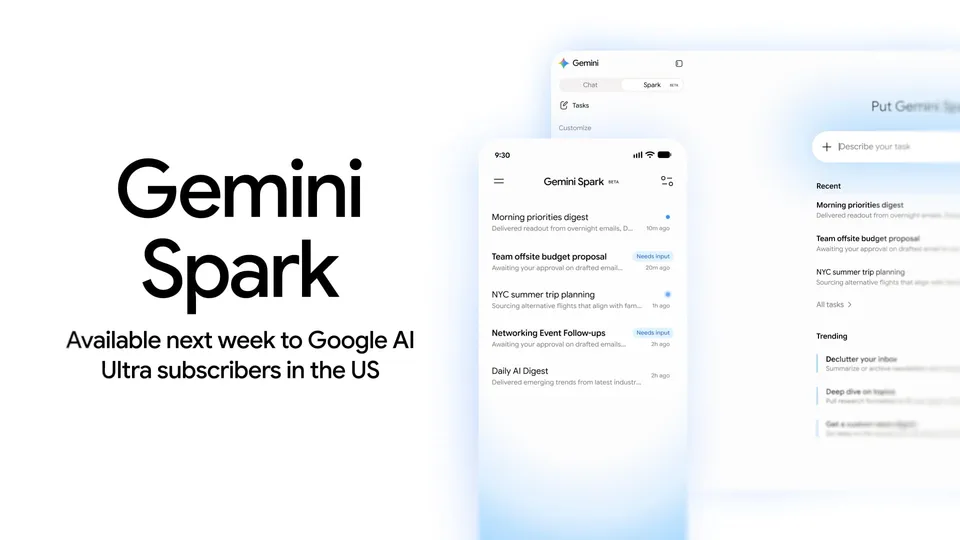
 Image via 9to5Google / Google
 Gemini Spark: Google's New 24/7 Agent Has Custom Sub-Agents on the Roadmap
Gemini Spark launched at I/O 2026 as a proactive cloud agent that handles tasks across Gmail, Docs, and Slides while you're offline. The detail buried in the announcement: custom sub-agents and a local browser are coming. Here's what shipped.
Google launched Gemini Spark at I/O 2026 today, the company’s first cloud-resident, always-on agent that runs whether your phone is locked, your laptop is closed, or you’re nowhere near a screen. Powered by Gemini 3.5 Flash, Spark sits inside the Gemini app and acts on your behalf across Gmail, Google Docs, Slides, and the broader Workspace stack.
For most users, this looks like a Siri-killer. For developers paying close attention, the announcement matters for a different reason: Google quietly previewed three roadmap items that would turn Spark into a programmable platform, not just a consumer agent.
What Spark Actually Does
Spark is the consumer-facing version of the same agent technology Google launched for developers today through Managed Agents in the Gemini API and Antigravity 2.0. The pitch from CEO Sundar Pichai on stage was that Spark is “an active partner that does real work on your behalf and under your direction.”
Demos shown at the keynote:
- Subscription audit. Spark parses your credit card statements, identifies recurring charges, and surfaces forgotten subscriptions.
- School email monitoring. It watches your inbox for deadlines, permission slips, and school-event notices, and creates a daily family digest.
- Meeting note consolidation. Spark takes scattered meeting notes across Docs and Slides, turns them into a polished summary, and drafts the follow-up emails.
- Recurring workflows. You can configure Spark to run a workflow on a trigger (every Friday at 5pm, or whenever a specific email lands), with permission gates for actions that spend money or send messages.
The high-stakes-action permission gate is Google’s answer to the safety concerns that have dogged every agent product in 2026. Spark will ask before purchasing anything, before sending a message externally, and before taking any action with financial or social consequences. Lower-risk actions (drafting an email, summarizing a doc) run automatically.
The Roadmap Items That Matter to Developers
The interesting items are not what shipped, but what’s coming. According to the Android Authority recap, Google previewed three near-term additions:
-
Texting and emailing with Spark. Today Spark lives in the Gemini app. Soon it will be addressable from SMS and email, meaning you can hand off a task by simply emailing it.
-
Custom sub-agents. Users will be able to define their own sub-agents that Spark can dispatch to. This is the same primitive Google launched today for developers via Managed Agents and Antigravity SDK, but exposed at the consumer Gemini app level.
-
Local browser operation. Spark will be able to take actions in a real browser session running on your behalf. This is the same capability OpenAI introduced with Perplexity’s Computer and Anthropic’s Computer Use. Google’s version, if it ships, would close the last major capability gap.
For developers, the second item is the most consequential. If consumers can define custom sub-agents in their Gemini app, the next obvious step is a marketplace or directory where developers publish sub-agents that any Gemini user can install. Google hasn’t announced this, but the shape is there. Custom sub-agents are the same primitive whether you call them from the Gemini API, from an Antigravity workflow, or from your phone.
How Spark Differs From the Agentic Coding Tools
For anyone who lives in Claude Code or Cursor, the question is whether Spark replaces or complements those tools.
Short answer: complements. Spark is built for the personal and consumer-task layer (subscriptions, schedules, email, document workflows), not for software engineering. The agent harness underneath is the same as Managed Agents and Antigravity, but the surface, the tools, and the model defaults are tuned for general productivity, not for shipping code.
Where this gets interesting is the overlap layer. A developer who wants Spark to handle their personal workflow (calendar, expense reports, contractor invoices) while Claude Code handles the day job is now a viable pattern. The cost difference matters too: Spark runs on AI Plus and AI Ultra subscriptions, not on per-token API billing. For high-volume personal use cases, the subscription model is dramatically cheaper than running the same workload through the Gemini API.
Availability
Spark rolls out to trusted testers this week, with a beta launch for U.S. Google AI Ultra subscribers expected next week. The two relevant pricing tiers are:
- AI Ultra (new tier): $100/month, includes Spark beta access
- AI Ultra (top tier): $200/month (reduced from $250), full Spark capabilities
Wider rollout to AI Plus ($19.99/month) is planned for later in 2026. Google has not committed to a free-tier version, and the company’s pattern on previous agent launches suggests Spark will remain a paid feature.
The Take
Spark is the consumer story for the same architecture Google shipped to developers this morning. The fact that the same agent harness powers Antigravity, Managed Agents, and the Gemini Spark app underlines the strategic bet: agents are the new center of Google’s product roadmap, and the same primitives serve power users and casual users alike.
For developers, two things matter from this announcement. First, custom sub-agents are coming to consumers, which means there will be a real audience for agent components that users can install. Second, the model and harness are now battle-tested across both consumer and developer surfaces, which usually improves quality faster than developer-only releases.
Whether Spark itself becomes a daily-use product depends on the demo holding up in the real world. Subscription audits and email digests are easy to show on stage and harder to ship reliably. The next four weeks of trusted-tester feedback will be the real test.
Sources: