 Cognition AI / cognition.ai
 Cognition Raises $1 Billion at $26B Valuation: Devin Writes 89% of Its Own Code
The maker of Devin and Windsurf closed a $1B Series D at a $26 billion post-money valuation, with $492M in annualized revenue and customers including Goldman Sachs, Mercedes-Benz, and NASA.
Cognition closed a $1 billion Series D on May 27, valuing the company at $26 billion post-money — more than 2.5 times its $10.2 billion mark from just eight months ago. Lux Capital, General Catalyst, and 8VC led the round. The company’s annualized revenue run-rate sits at $492 million.
Cognition makes Devin, the autonomous software engineering agent, and owns Windsurf, the AI coding IDE it acquired from Codeium’s remnants in late 2025 after Google hired away Windsurf’s original founders in a $2.4 billion talent deal.
The 89% number
The most striking data point in the announcement isn’t the valuation. It’s that Devin now writes 89% of Cognition’s own production code. The company is building its product with the product.
That number is notable for a reason beyond the obvious. It’s a direct benchmark — not a synthetic one. Cognition’s codebase, built by a team that presumably knows what quality looks like, is 89% AI-authored. That’s the clearest signal yet that autonomous coding agents have moved past demo-level capability into something teams actually trust with real work.
Customers and use cases
The disclosed customer list includes Goldman Sachs, Mercedes-Benz, Citi, Santander, Dell, NASA, the US Army, and the US Navy. That mix is worth paying attention to: financial services and defense customers have high bars for reliability and security. Their presence suggests Devin’s enterprise offer has matured past the early-adopter phase.
Cognition hasn’t said much about specific deployments, but the pattern fits what’s been public for a while: enterprise customers use Devin for the kind of repetitive engineering work that’s expensive in human hours — migrations, test generation, documentation, refactoring legacy code.
Where the valuation comes from
$26 billion on $492 million ARR is a roughly 52x revenue multiple. That’s high, even by current AI standards. A few things explain it.
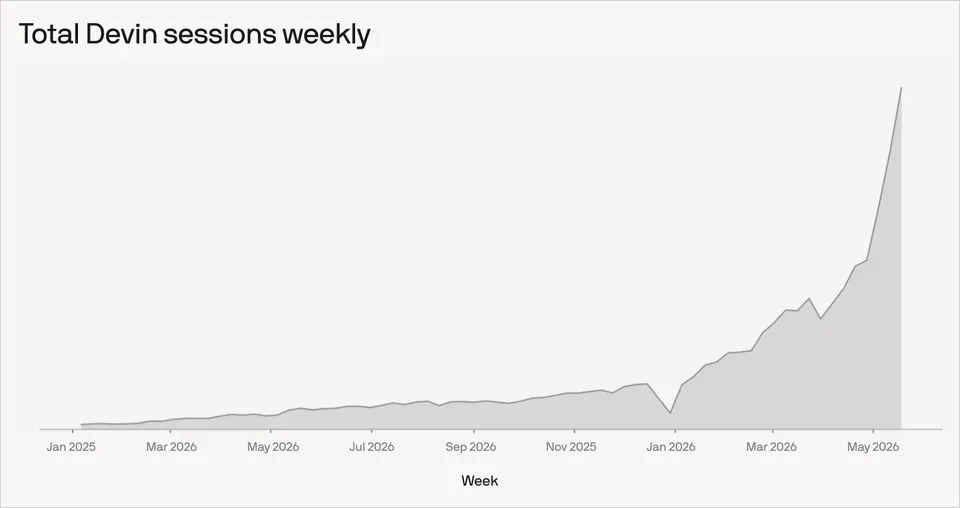
First, the growth rate. Going from roughly $60M to $492M ARR in under a year implies a compounding rate that most SaaS companies never hit. If that trajectory holds for another 18 months, today’s multiple looks more reasonable.
Second, the asset mix. Cognition isn’t just a software company. It owns Windsurf, which had $82 million in ARR at acquisition and a large developer install base. Combined with Devin’s enterprise contracts, the portfolio has multiple distinct revenue streams.
Third, timing. AI coding agent adoption is still early. The market for autonomous software development tooling is being priced on optionality, not just current revenue.
What this means for the category
Cognition’s raise follows Modal Labs’ $355 million Series C two weeks ago. Both rounds point to the same thing: the infrastructure and agent layer of AI software development is attracting serious capital, and the companies in that space are growing fast enough to justify it.
Devin and Windsurf are now under the same roof, which means Cognition controls both an autonomous terminal agent and a full IDE. That combination puts it in a different strategic position than most of the other players in the category, who focus on one surface or the other.
The $1 billion raise gives Cognition runway to build out both products at scale without needing to optimize for short-term revenue efficiency. That’s the point of rounds at this size.